In the heart of Kathmandu Valley, artist SUSHILA SINGH draws lines with purpose. Each stroke carries the weight of heritage, reverence for ritual, and the urgency of preservation. Working primarily in monochrome pen-and-ink, Sushila has emerged as one of Nepal’s most distinctive contemporary voices, and artist who transforms the sacred geometry of Newari culture into powerful visual narratives that speak to both tradition and transformation.
Sushila specializes in bold line drawings that capture traditional elements of Kathmandu Valley heritage, architecture, and customs. Yet her practice extends beyond documentation. She embraces international art forms adapted through Nepali motifs, including Kintsugi, the Japanese art of golden repair, which she reinterprets through her cultural lens. Her issue-based installations, particularly those exploring women’s struggles, demonstrate an artist unafraid to blend the ancestral with the contemporary, the sacred with the political.
By: Presha Maharjan
PS this article was published on January – February 2026 issue of ECS Living
Growing Up in a Living Heritage
Sushila’s artistic journey began in the intimate spaces of her Newari household. “I came from the Newari culture,” she explains. “That culture and art would be implied in every step and every occasion. Our wary of doing things feels so amazing, and those things used to attract me to understand it better.” Before she ever considered herself an artist, she was fascinated by the ritual, occasions, and festivals that structured her family’s life.
Growing up around Patan Durbar Square, a living heritage site, profoundly shaped her visual sensibility. “From the small temples to the statues of the gods, the abstract form of the gods, I was very intrigued and fascinated by all these things,’ she recalls. “I used to wonder how our ancestors were able to create such architecture and such amazing pieces of art. “This childhood wonder evolved into a lifelong commitment to understanding and preserving these artistic traditions. Her formative influences emerged organically from domestic spaces; her kitchen, puja room, and home became her first galleries, her first teachers. This grounding in everyday sacred practice distinguishes her work from artists who approach cultural subjects from a purely academic distance.
The Sacred Geometry of Self-Worship: Mha Puja and Mandalas
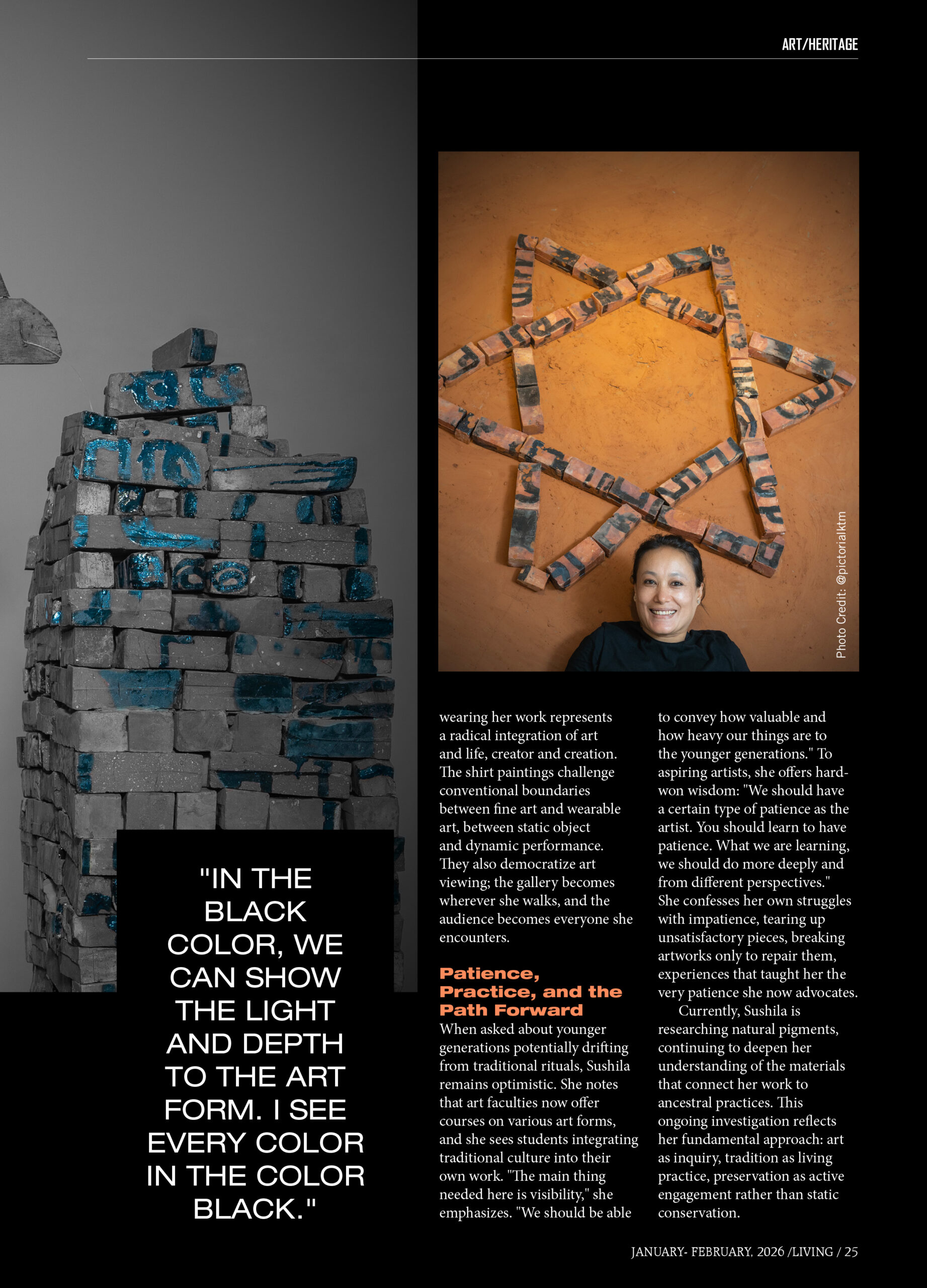
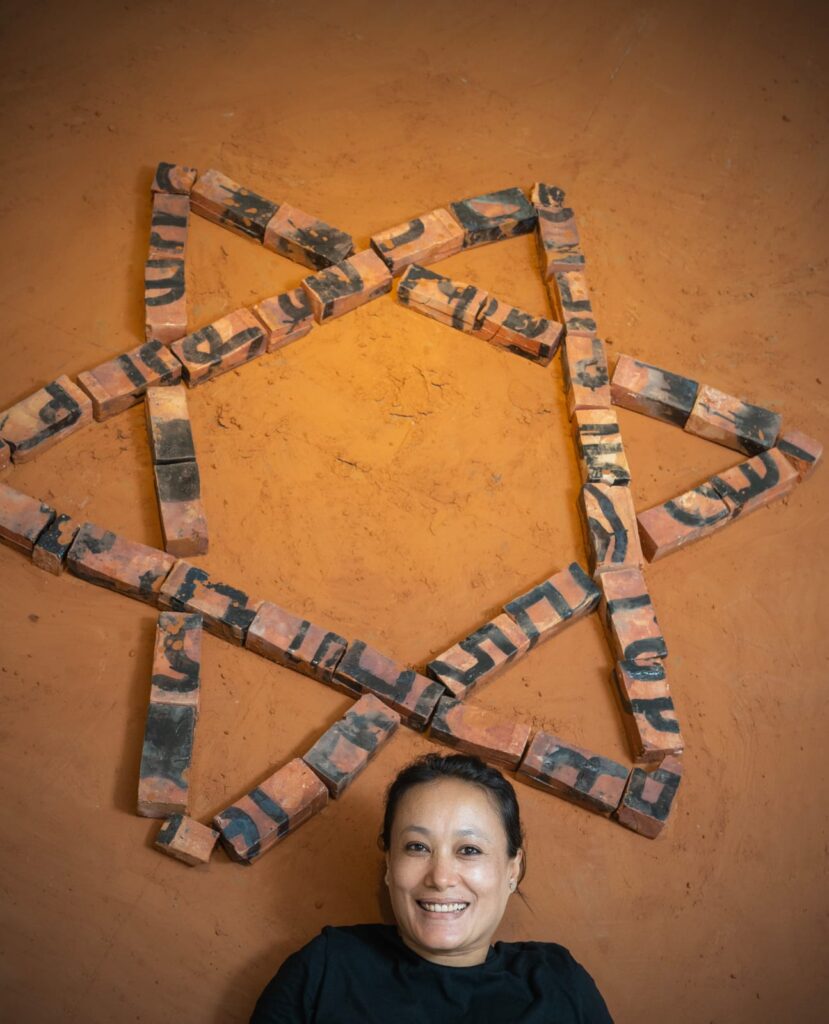
Among the most striking elements in Sushila’s recent work are her interpretations of Mha Puja, the Newari festival of self-worship, and the intricate mandalas associated with it. Selected for the Indian Art Fair 2025, these pieces explores a ritual unique in its focus on the living self. “We can see that no one worships themselves or does puja of themselves,” she points out. “But Mha Puja does it to the living body for the longevity and prosperity of oneself:
The mandalas she creates draw inspiration from patterns made during Mha Puja using locally sourced items from the five elements (panchatatwa): beans, wheat, and other grains arranged in the symbolic designs. These works, though rooted in ancient practice, only recently entered her artistic repertoire in 2025, demonstrating her ongoing evolution as an artist.
For Sushila, the festival represents more than cultural practice; it embodies a philosophy of self-care and self-honor that resonates with contemporary concerns about mental health and personal worth. Through her art, she makes visible the deep wisdom embedded in traditions that modern life often overlooks.
The Power of Black and Orange;’ A Monochrome Philosophy
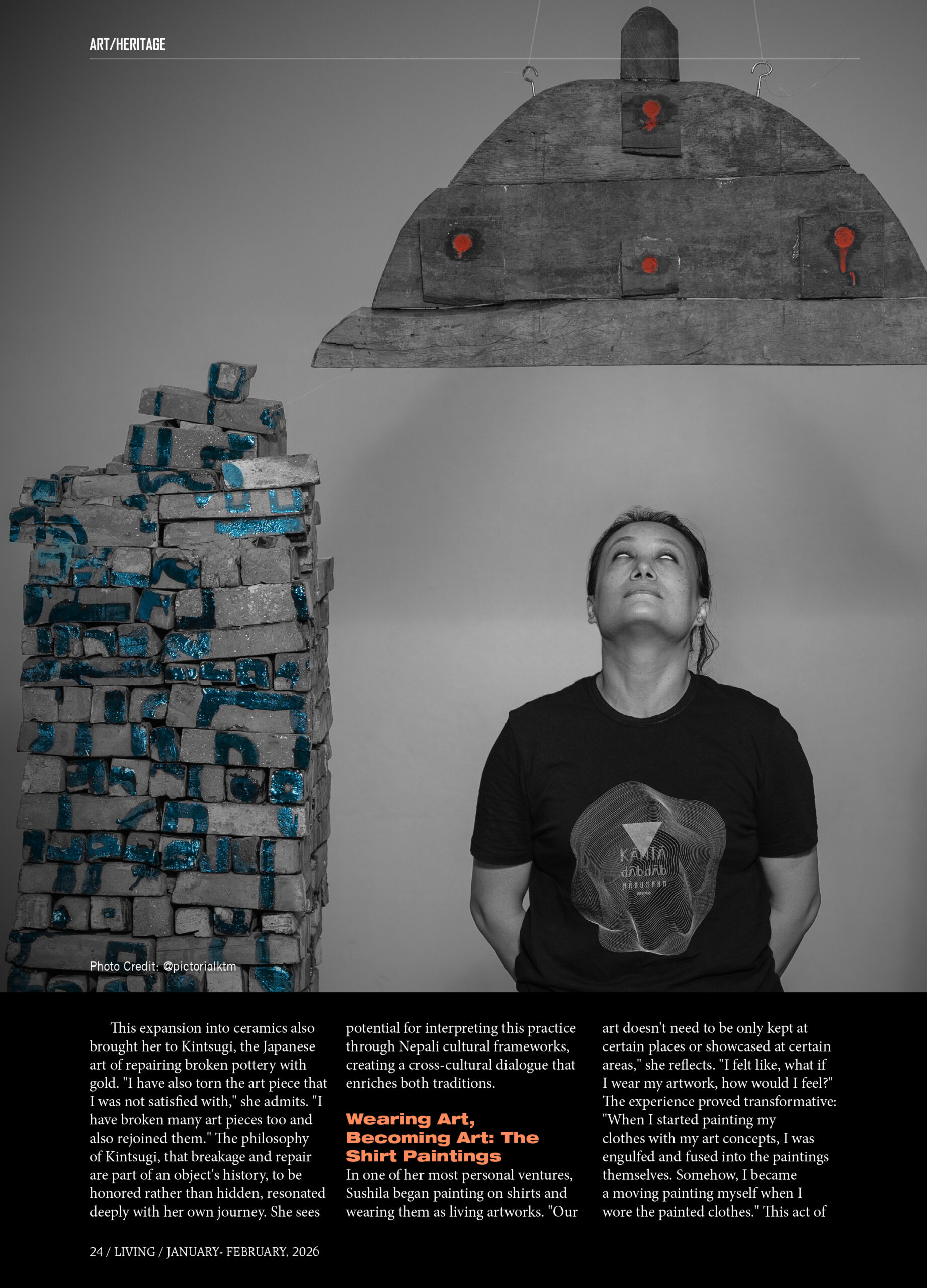
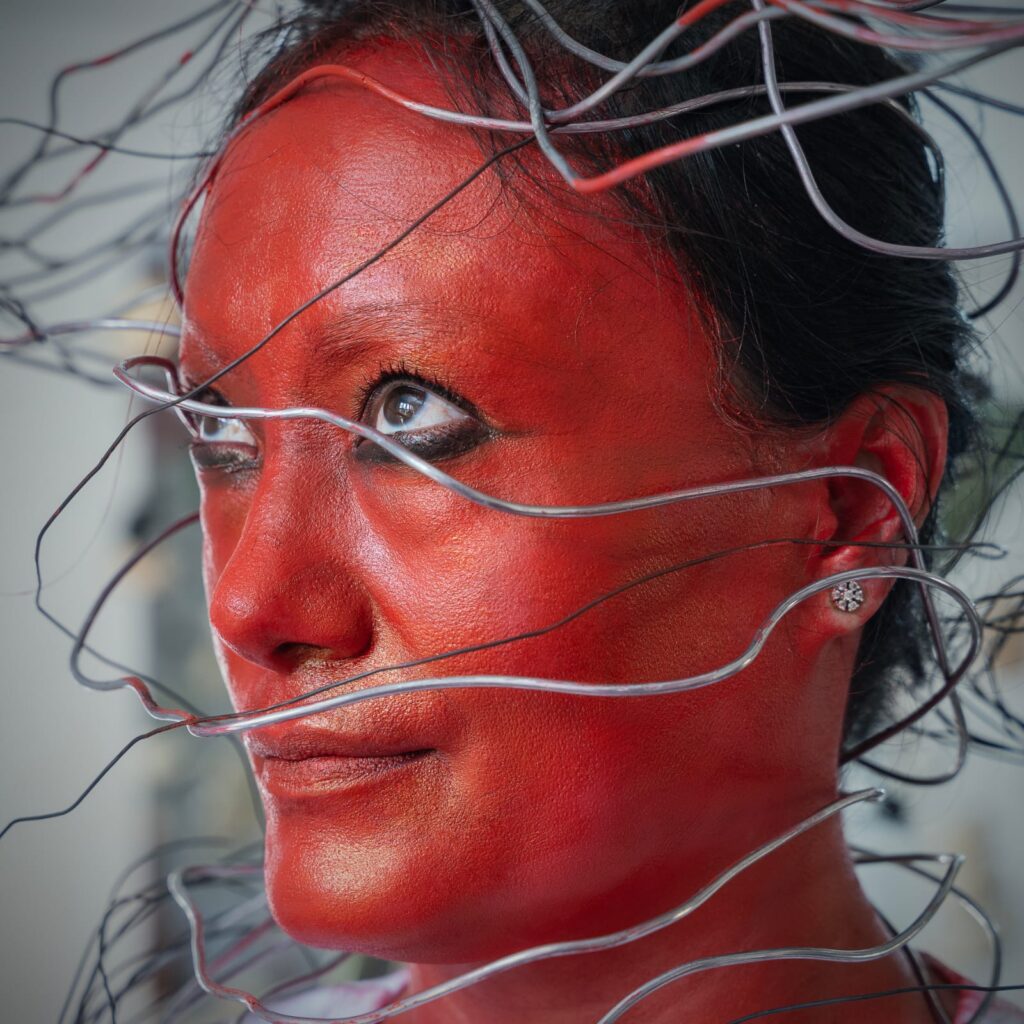
Sushila’s signature aesthetic, powerful black lines occasionally punctuated by vibrant orange, emerged from both artistic exploration and cultural symbolism. Though trained in various media, from oil paints to pastels and watercolours, she found her true voice in the stark clarity of pen and ink. “In the black clolor, we can show the light and depth to the art form,’ she explains. “I see every color in the color black.”
The addition of orange came from a deeply personal place. In the traditional puja thali, there is mohni sina (black color) and Bhuyu sina (orange color). “These are not just colors but the blessings provided to me,’ she says. “These were integrated into our culture and childhood, and these carry meaning to my art. Art without meaning is not art.” This deliberate limitation of palette serves multiple purposes: it creates visual consistency, references the ceremonial substances of her upbringing, and challenges her to find infinite variation within constraint. The result is a distinctive visual language immediately recognizable yet endlessly nuanced.
Jana Ba Dyo: Documenting Devotion Through 19 Days of Labor
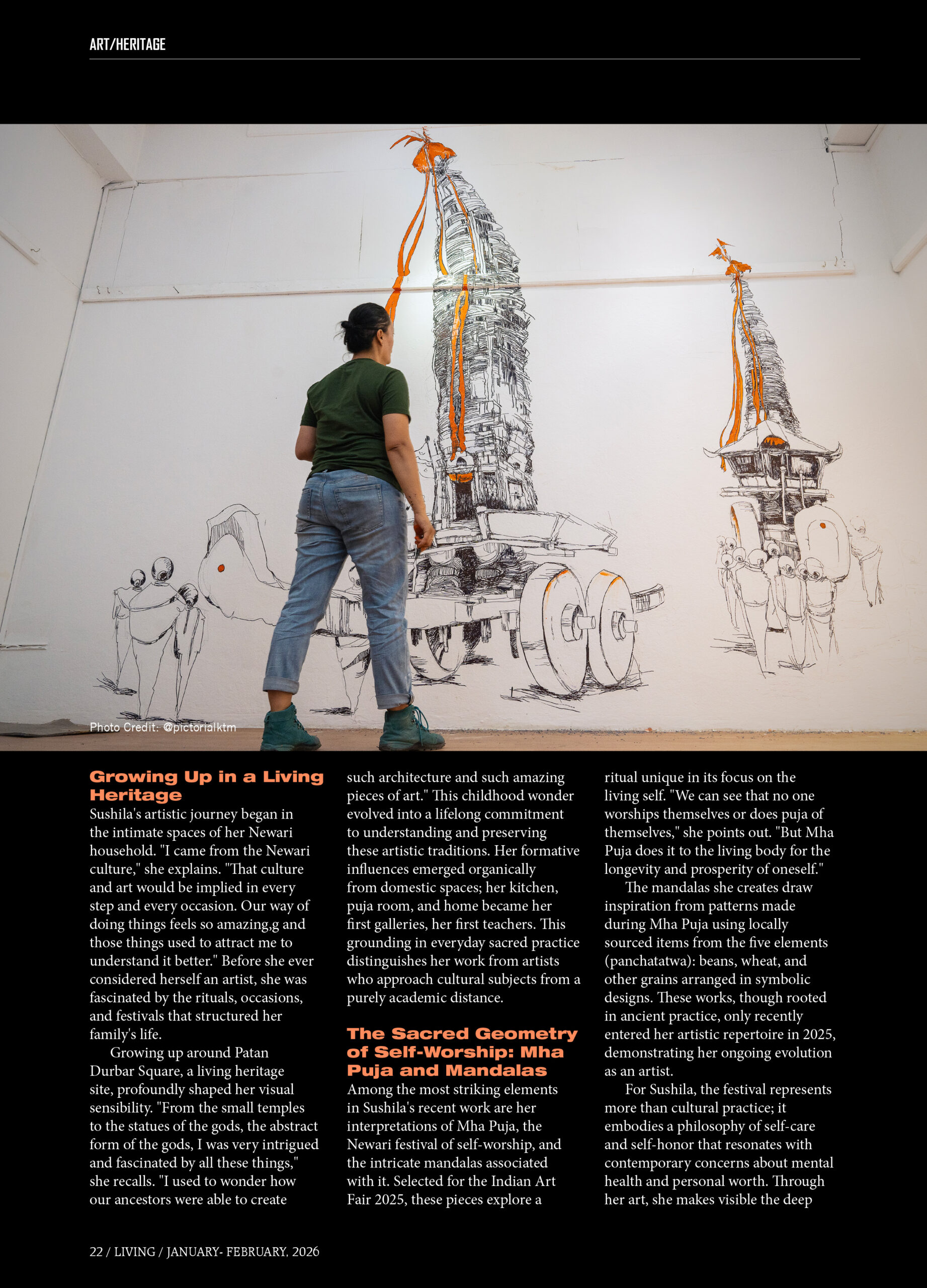
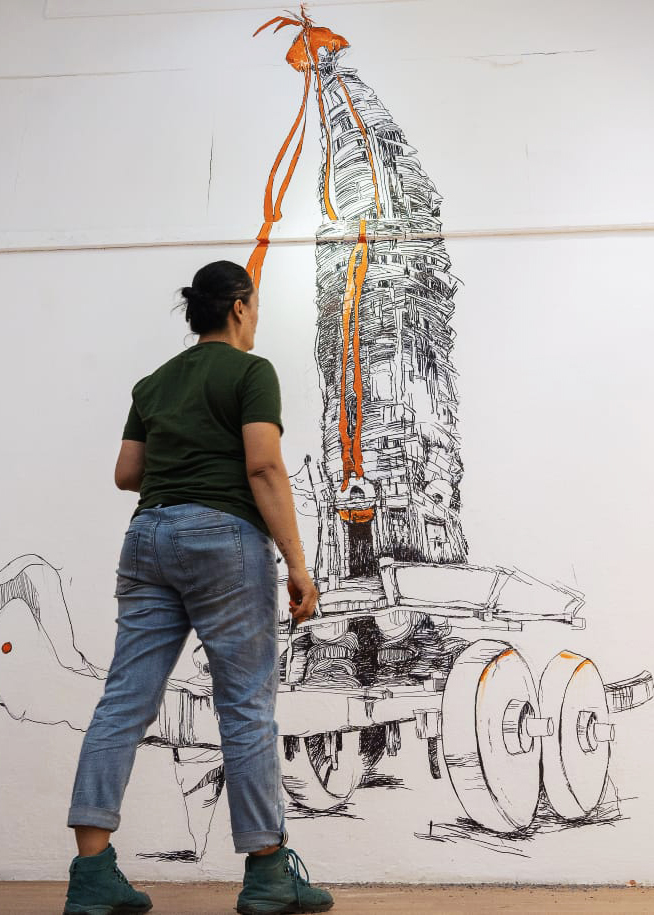
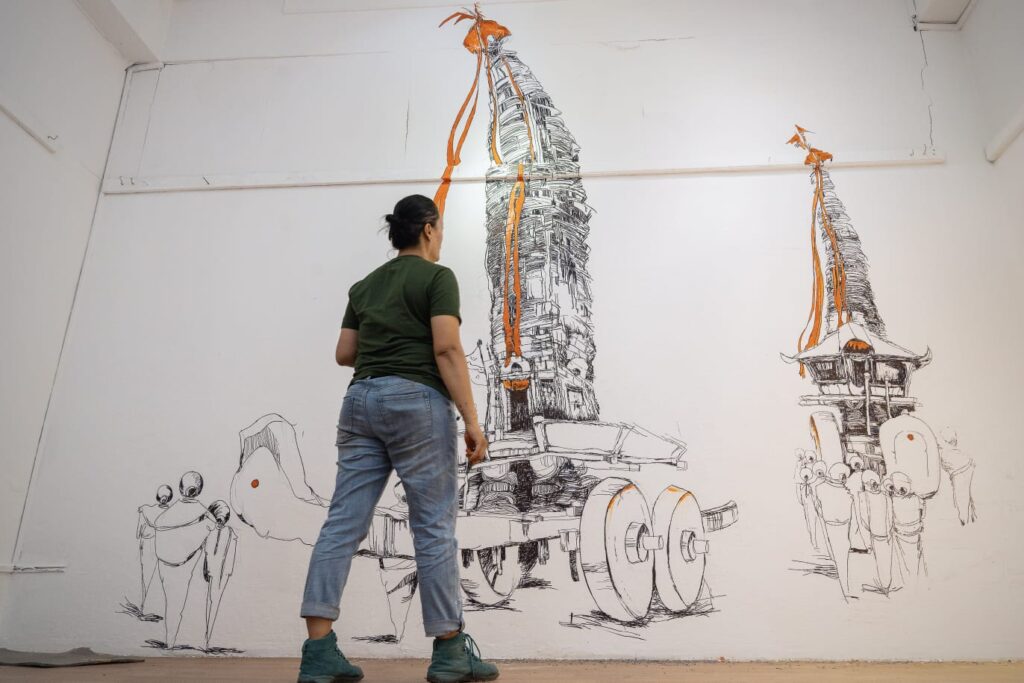
Perhaps no project better demonstrates Sushila’s commitment to cultural documentation than her Jana Ba Dyo series, a comprehensive visual record of the Seto Machindranath chariot procession. The series captures not just the completed spectacle but the entire 19-day process of constructing the massive chariot that carries the deity through Kathmandu’s streets. The project evolved organically from her art school routine. On her daily commute, she would pass through Pulchowk, where the Rato Machindranath chariot is kept for a month each year. Her teachers encouraged students to portray the jatra in various art forms, focusing on specific details rather than attempting to capture everything at one. Year after year, she returned to the subject, growing more fascinated each time. “I thought to myself that the chariot-making work of 19 days, I would definitely complete it,” she recalls. “But that was only possible in 2022.” Between 2022 and 2023 she finally completed the full cycle, documenting each day from the first timber binding to the final ornamental touches.
Through meticulous sketches, Sushila captures the spirit, labour, and devotion behind this sacred ritual. The exhibition presents viewers with an intimate view of the meticulous craftsmanship involved, from the binding of the wooden framework to the sacred ornaments that adorn it. The series stands as a testament to her belief that preservation requires more than photographing finished products; it demands understanding and honouring the process that create them.
Beyond the Canvas: Clay, Kintsugi, and the Three-Dimensional Turn
In 2018, Sushila expanded her practice into clay work, discovering a transformative new dimension to her artistic expression. “Usually, I work in the one-dimensional form, in front only, canvas,” she explains. “But when I did the clay, it was the work of the three-dimensional art form. That was really amazing work for us.” Working with clay offered her direct engagement with the five elements (panchatatwa), creating what she describes as a form of therapy. She became particularly drawn to blackware, the ancient technique of creating black ceramics through controlled firing. For her Genesis of Self exhibition, she created traditional Newari plates (dyahbhu) as metaphors for healthy living and good habits, incorporating the mandala patterns from Mha Puja into functional ceramic forms.
This expansion into ceramics also brought her to Kintsugi, the Japanese art of repairing broken pottery with gold. “I have also torn the art piece that I was not satisfied with,” she admits. “I have broken many art pieces too and also rejoined them.” The philosophy of Kintsugi, that breakage and repair are part of an object’s history, to be honoured rather than hidden, resonated deeply with her own journey. She sees potential for interpreting this practice through Nepali cultural frameworks, creating a cross-cultural dialogue that enriches both traditions.
Wearing Art, Becoming Art: The Shirt Paintings
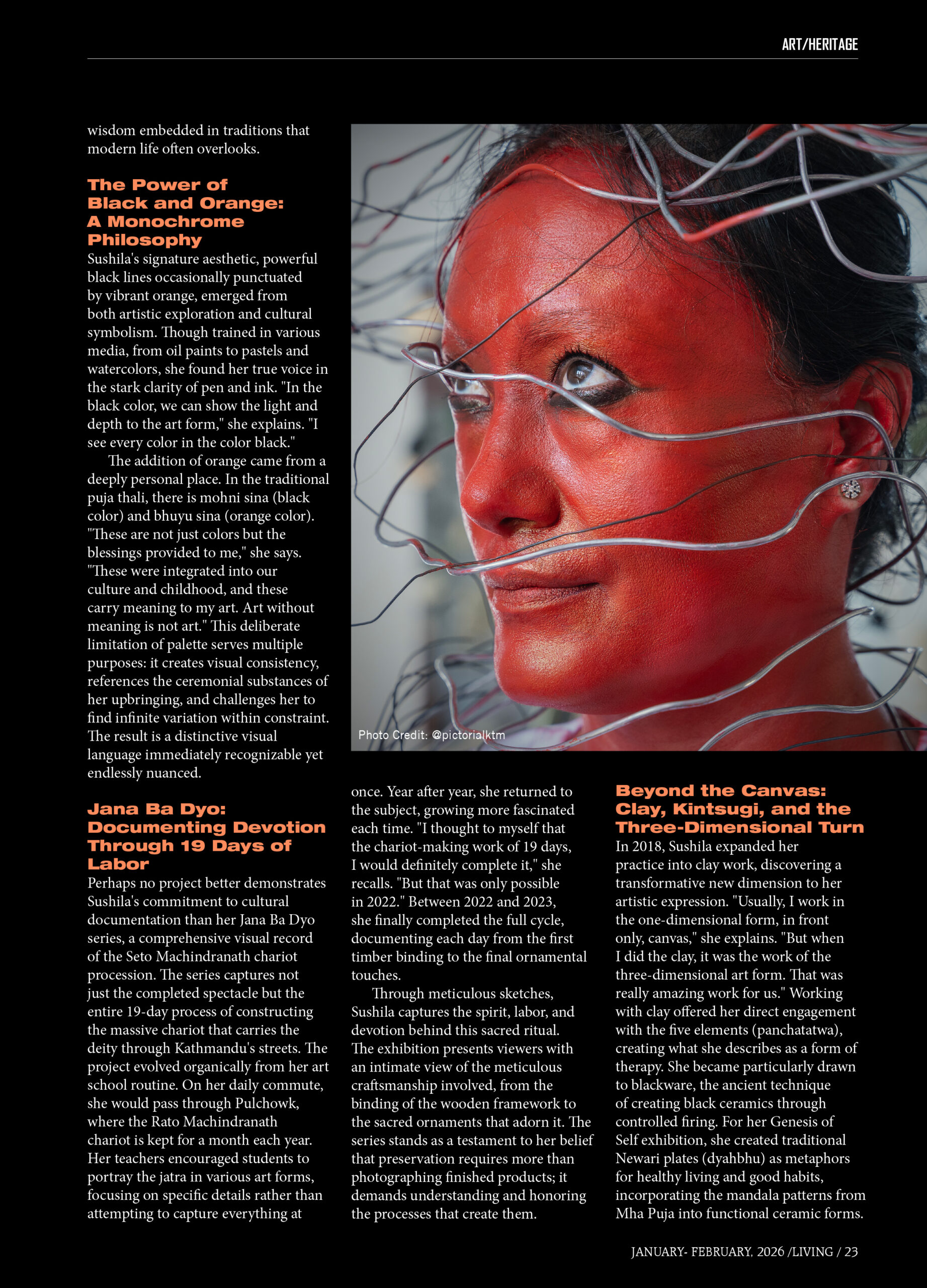
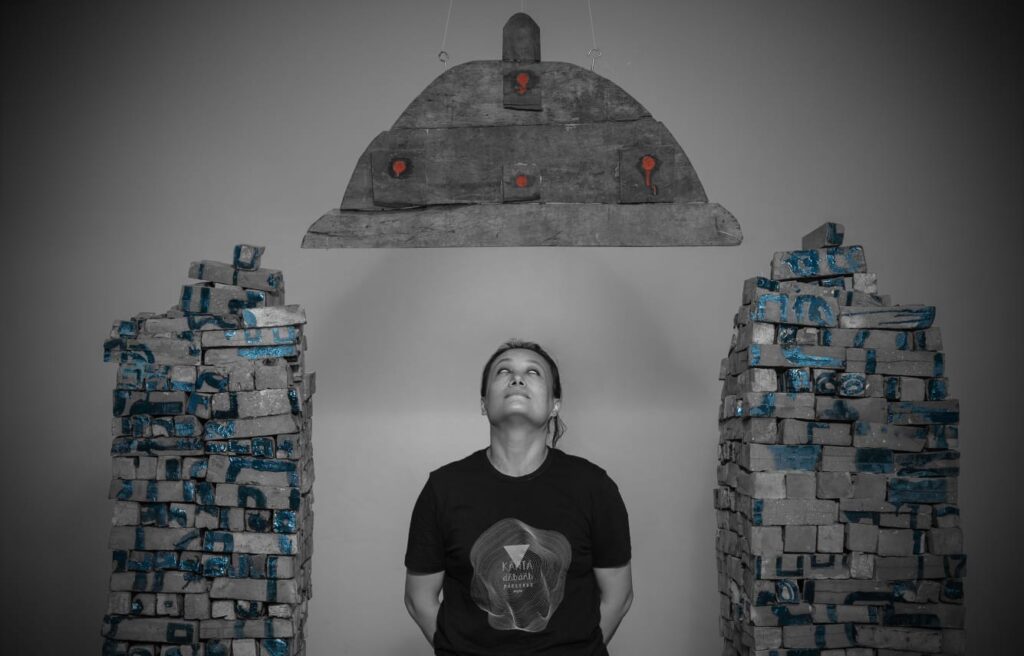
In one of her most personal ventures, Sushila began painting on shirts and wearing them as living artworks. “Our art doesn’t need to be only kept at certain places or showcased at certain areas,” she reflects. “I felt like, what if I wear my artwork, how would If eel?”The experience proved transformative: “When I started painting my clothes with my art concepts, I was engulfed and fused into the paintings themselves. Somehow, I became a moving painting myself when I wore the painted clothes.” This act of wearing her work represents a radical integration of art and life, creator and creation. The shirt paintings challenge conventional boundaries between fine art and wearable art, between static object and dynamic performance. They also democratize art viewing; the gallery becomes wherever she walks, and the audience becomes everyone she encounters.
Patience, Practice, and the Path Forward
When asked about younger generations potentially drifting from traditional rituals, Sushila remains optimistic. She notes that art faculties now offer courses on various art forms, and she sees students integrating traditional culture into their own work. “The main thing needed here is visibility, she emphasizes. “We should be able to convey how valuable and how heavy our things are to the younger generations.” To aspiring artists, she offers hard-won wisdom: “We should have a certain type of patience as the artist. You should learn to have patience. What we are learning, we should do more deeply and from different perspectives.”
She confesses her own struggles with impatience, tearing up unsatisfactory pieces, breaking artworks only to repair them, experiences that taught her the very patience she now advocates.
Currently, Sushila is researching natural pigments, continuing to deepen her understanding of the materials that connect her work to ancestral practices. This ongoing investigation reflects her fundamental approach: art as inquiry, tradition as living practice, preservation as active engagement rather than static conservation.